
Some casino bonuses look strong at first glance because the headline is large, the deposit requirement appears low, or the promotion sounds simple to claim. For New Zealand readers, though, a bonus that looks attractive on the surface can still offer limited real value once the practical terms are taken into account.
This guide explains how to spot a casino bonus that looks good but offers low real value in NZ, what warning signs usually matter most, and why some promotions feel much weaker in practice than they do in advertising. The aim is not to promote any operator, but to help readers judge bonuses more realistically before depositing or opting in.
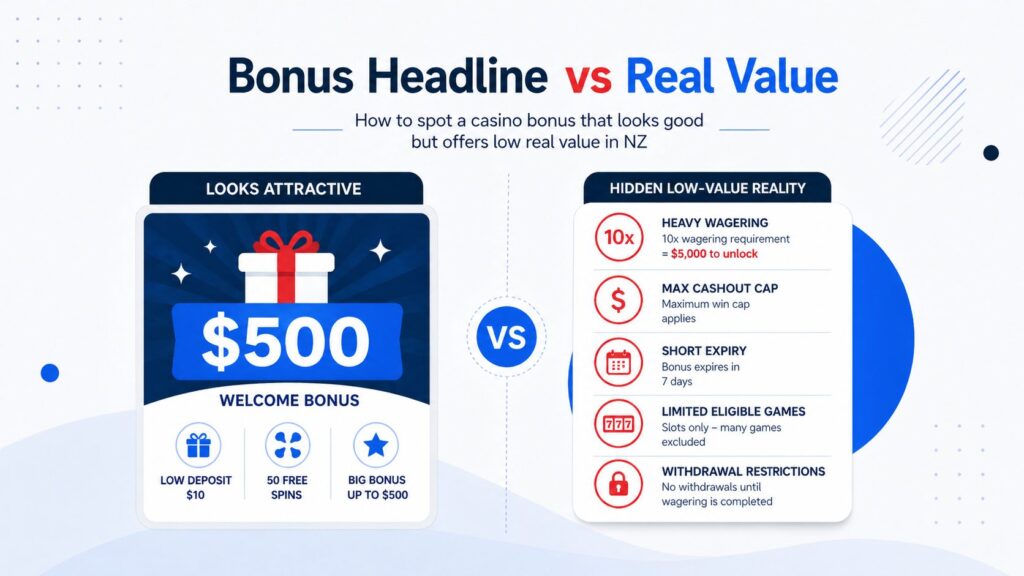
Quick answer: a casino bonus may offer low real value if the headline looks attractive but the practical conditions are restrictive. Common warning signs include heavy wagering, tight payout caps, limited eligible games, short time limits, awkward withdrawal rules, and bonus structures that sound better than they actually work.
Contents
- Why do some bonuses look better than they really are?
- Which warning signs usually point to low real value?
- How can wagering make a bonus look stronger than it is?
- Why do payout restrictions matter so much?
- How can bonus format hide weak practical value?
- What makes a bonus more usable in practice?
- What should NZ players check before claiming a bonus?
- Editorial summary
- FAQ
Why do some bonuses look better than they really are?
Some bonuses look stronger than they really are because the marketing headline highlights the most attractive part of the promotion while leaving the practical restrictions in the background. In many cases, the visible number creates the impression of value, but the terms decide whether that value is realistic.
A large matched deposit, a generous free spins total, or a simple “claim now” message can all make an offer feel more accessible than it really is. But the user does not experience the headline alone. The real experience depends on the full structure of the promotion, including wagering, payout restrictions, eligible games, expiry windows, and what happens later at withdrawal stage.
This is one reason it helps to start from the broader logic behind why casino bonus terms matter more than the headline in NZ before assuming that a good-looking promotion is automatically good value.
Which warning signs usually point to low real value?
The clearest warning signs are usually the conditions that make a bonus harder to complete, harder to use, or less rewarding at withdrawal stage than the headline first suggests. A bonus does not have to be “bad” in absolute terms to offer low practical value for the average player.
Heavy wagering
If a bonus requires a large amount of play-through before winnings may be withdrawn, the real effort behind the offer may be much greater than the headline implies.
Restricted eligible games
If only a narrow group of games counts properly, the player may not be able to use the bonus naturally or efficiently.
Short time limits
A bonus can lose much of its practical value if the completion window feels too tight for realistic use.
Withdrawal caps or payout rules
Even a good-looking promotion can become weak in practice if winnings are capped or the withdrawal structure limits the real upside sharply.
How can wagering make a bonus look stronger than it is?
Wagering is one of the clearest reasons a bonus may look attractive at headline level while offering less practical value than expected. The visible promotional amount may be large, but the required play-through can still make the offer difficult to complete realistically.
This matters because two bonuses with similar headline numbers can feel very different once the wagering is considered seriously. A smaller offer may sometimes be more usable than a bigger one if the play-through is lighter, the eligible games fit better, or the completion path is more realistic overall.
If you want that term unpacked more directly, it helps to see what wagering requirements are in NZ casinos. In practice, this is often one of the first terms that separates a strong-looking bonus from a genuinely usable one.
Why do payout restrictions matter so much?
Payout restrictions matter because the practical test of a bonus usually comes at withdrawal stage, not at claim stage. A promotion may look easy to activate, but the final value still depends on how much can actually become withdrawable once the rules are applied.
One of the clearest examples is a max cashout rule. A bonus may create strong first impressions with a large headline amount, but if the winnings are capped at a relatively modest level, the real upside can be much lower than expected. That is why it helps to understand how max cashout rules work in NZ casino bonuses instead of treating all bonuses as open-ended value.
The same logic applies more broadly to the withdrawal path. A player comparing bonuses realistically should also think about the later payout stage, which is why articles such as how casino withdrawals work in NZ still matter in a bonus context.
How can bonus format hide weak practical value?
Bonus format matters because different types of promotions create different expectations and different friction points. A bonus can look attractive simply because the format sounds accessible, even if the real conditions behind it are relatively restrictive.
No deposit offers
No deposit bonuses often attract attention because they appear to remove the need for upfront spending. But in practice, payout caps, verification, and later restrictions can still reduce the real value significantly.
Free spins offers
Free spins can sound straightforward, but their usefulness depends on which games they apply to, how winnings are converted, and whether extra conditions still stand between the player and a withdrawal.
Low deposit promotions
A small deposit requirement may look efficient at first glance, but it does not automatically make the bonus better. The real comparison still depends on the full structure of the offer, not only the low entry point.
This is why it helps to compare the broader types of casino bonuses in NZ rather than treating every format as if it delivers value in the same way.
What makes a bonus more usable in practice?
A bonus becomes more usable when the structure feels realistic from claim stage to withdrawal stage. The best offers are not always the ones with the biggest headlines, but the ones whose terms fit how a player would actually use them.
Clearer terms
A bonus is easier to trust and compare when the rules are understandable before the player opts in.
More realistic conditions
Lighter play-through, practical time limits, and better-aligned eligible games often make a bonus feel more usable in the real world.
Lower friction later
A more practical bonus is also less likely to create surprises at withdrawal stage through payout caps, misunderstood restrictions, or bonus-related review issues.
This is also why it helps to see how to compare casino bonuses in NZ without focusing only on the headline, because the strongest comparison framework usually points toward real usability rather than visual appeal.
What should NZ players check before claiming a bonus?
Before claiming a casino bonus, NZ players should look beyond the promotion box and assess whether the full structure feels realistic. In most cases, the most useful checklist includes:
- whether the wagering looks practical rather than merely possible on paper
- whether the eligible games fit how the player actually wants to use the bonus
- whether a max cashout or other withdrawal cap applies
- whether the expiry period feels realistic
- whether the bonus format itself is more attractive in theory than in practice
- whether the withdrawal and verification path still looks reasonable later on
If the bonus first appears attractive because it sounds especially easy to claim, it can also help to compare that impression against practical guides such as how to claim a no deposit bonus in NZ or what free spins bonuses are in NZ, because both formats are often misunderstood at headline level.
Editorial summary
A casino bonus can look good but still offer low real value if the practical terms are restrictive. The headline may attract attention, but the actual user experience depends on wagering, game eligibility, payout rules, time limits, and what happens later when the player tries to withdraw.
The most useful takeaway is simple: do not judge a bonus by how strong it looks in advertising alone. Check whether the full structure is realistic, usable, and still makes sense once the headline is stripped back to the rules behind it.
FAQ
Can a casino bonus look good but still offer weak real value?
Yes. A strong headline can still hide restrictive terms that make the offer harder to use or less rewarding at withdrawal stage.
What is one of the biggest warning signs in a bonus?
Heavy wagering is often one of the clearest warning signs, especially when the headline makes the promotion look easier than it really is.
Do payout rules matter as much as the bonus amount?
Yes. Payout restrictions such as max cashout can reduce the real value of a promotion even if the headline looks generous.
Are all bonus formats equally useful in practice?
No. No deposit bonuses, free spins offers, and low deposit promotions can all work very differently once their terms are applied.
What should NZ players do before claiming a casino bonus?
They should check the full structure of the offer, including wagering, eligible games, payout rules, time limits, and how realistic the bonus looks from claim stage to withdrawal.
Last updated: April 2026
Related Posts