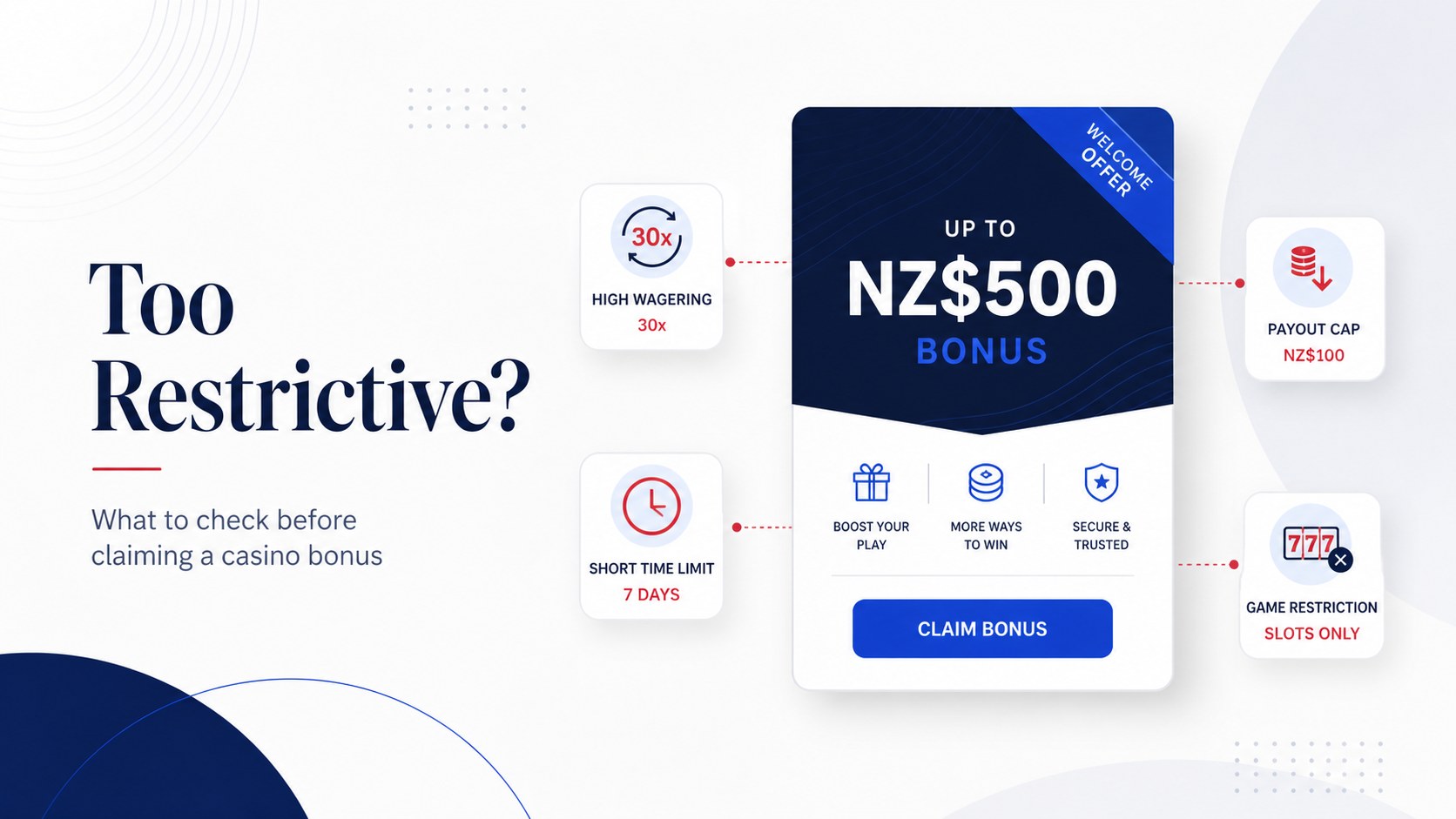
Some casino bonuses do not look obviously bad at first glance. The headline may seem decent, the deposit requirement may look manageable, and the promotion may appear similar to many others. For New Zealand readers, though, the real question is not only whether a bonus exists, but whether the conditions make it too restrictive to offer practical value.
This guide explains how to tell if a casino bonus is too restrictive in NZ, which conditions usually matter most, and how players can recognise when an offer has crossed the line from usable promotion to low-practical-value deal. The aim is not to promote any operator, but to help readers judge bonus offers more realistically before depositing or opting in.
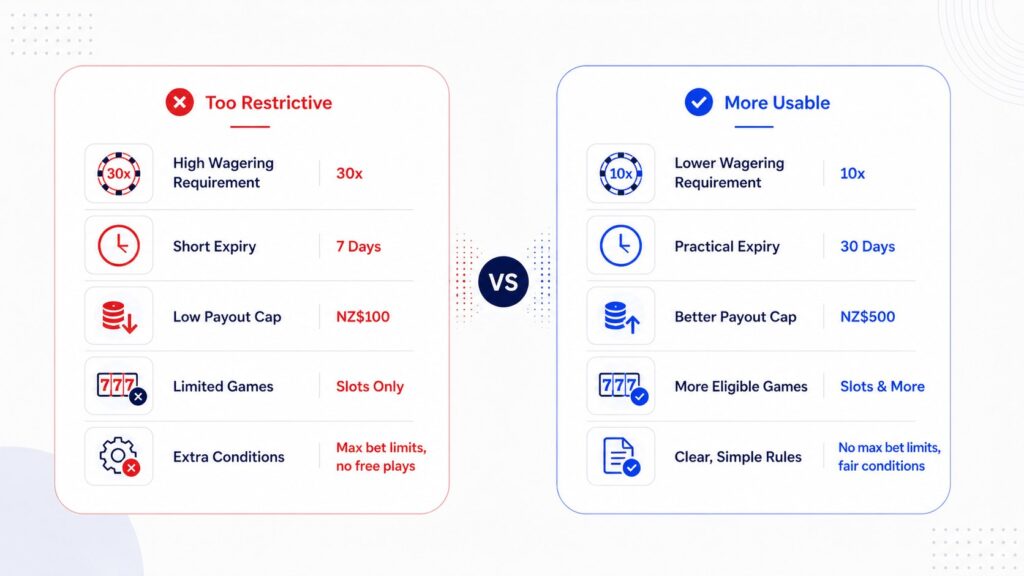
Quick answer: a casino bonus may be too restrictive if the conditions make it difficult to use naturally or reduce the realistic chance of turning bonus value into a practical withdrawal. Common warning signs include heavy wagering, tight expiry, narrow eligible games, max cashout caps, strict max bet rules, and bonus structures that create too much friction relative to the headline offer.
Contents
- What does “too restrictive” actually mean?
- Which bonus terms most often make an offer too restrictive?
- How can wagering and time limits make a bonus unrealistic?
- Why do payout caps and max bet rules matter so much?
- How can game restrictions reduce the real usefulness of a bonus?
- When does a bonus look fine on paper but still feel too limited?
- What should NZ players check before claiming a bonus?
- Editorial summary
- FAQ
What does “too restrictive” actually mean?
A bonus is usually too restrictive when the conditions make it difficult to use naturally, difficult to complete realistically, or difficult to turn into practical withdrawable value later. The issue is not that the offer has terms at all, but that the total structure creates too much friction compared with what the headline promises.
In practice, “too restrictive” does not always mean the offer is impossible. It often means the bonus looks better in marketing than it feels in real use. A player may technically be able to claim it, but the effort, limitations, or later restrictions may make the practical value much lower than expected.
This is one reason it helps to understand why casino bonus terms matter more than the headline in NZ before treating any offer as automatically worthwhile.
Which bonus terms most often make an offer too restrictive?
The most restrictive bonus terms are usually the ones that make the offer harder to use, harder to complete, or less useful at withdrawal stage. In most cases, a few recurring conditions decide whether the promotion still feels reasonable or has become too limited to justify the effort.
Heavy wagering
If the play-through requirement is high relative to the size or format of the bonus, the offer may become much less attractive in practice.
Short expiry
If the completion window is too tight, the bonus may only look usable in theory rather than in a realistic player journey.
Narrow eligible games
If only a small set of games counts properly, the player may not be able to use the promotion naturally.
Payout restrictions
If winnings are capped or structured too tightly, the bonus may offer much less upside than the headline first suggests.
Max bet rules
Strict bet-size rules can make a bonus less practical and can create avoidable friction if overlooked.
How can wagering and time limits make a bonus unrealistic?
Wagering and time limits are two of the biggest reasons a bonus can move from reasonable to overly restrictive. Even when the headline looks attractive, the real path to completion may become unrealistic if the play-through is too heavy or the expiry window is too short.
This matters because a player does not experience wagering as an abstract number. They experience it through the time, game selection, and practical effort needed to move through the offer. If the expiry window is tight on top of that, the bonus can quickly become more theoretical than genuinely usable.
For a fuller explanation of the play-through side, it helps to read what wagering requirements are in NZ casinos. That article explains the term itself, while this one focuses on the point where the condition becomes too restrictive to feel worthwhile.
Why do payout caps and max bet rules matter so much?
Payout caps and max bet rules matter because they often reduce the practical value of the offer in ways that are easy to underestimate at claim stage. A bonus may look generous at first, but the actual outcome can still be tightly controlled once those rules are applied.
A max cashout cap is one of the clearest examples. The headline may create the impression of open-ended upside, while the terms still limit how much can actually be withdrawn from bonus-related winnings. In that case, the bonus may still function, but the real value can be much lower than the promotional framing suggests.
This is why it helps to understand how max cashout rules work in NZ casino bonuses before judging whether a promotion is genuinely flexible or just looks that way.
Max bet rules can also matter more than players expect. Even if the bonus seems manageable overall, strict staking limits may create extra friction or increase the chance of accidental rule breaches if the terms are not read carefully first.
How can game restrictions reduce the real usefulness of a bonus?
Game restrictions matter because a bonus only feels practical if it can be used in ways that match how the player actually intends to play. If the eligible games are too limited, the promotion may become much less useful even when the headline remains attractive.
Limited contribution
Some games may contribute differently toward the bonus conditions. That can make the offer feel weaker if the player’s preferred game types do not count well enough.
Format mismatch
A free spins package, a no deposit offer, and a deposit bonus can all create different restrictions around how the promotion is actually used. A bonus may look generous while still being tied to a very narrow practical route.
This is one reason it helps to review the broader types of casino bonuses in NZ rather than assuming all formats deliver value in the same way.
When does a bonus look fine on paper but still feel too limited?
A bonus can look acceptable on paper and still feel too restrictive when the total structure creates more friction than the offer is worth. This usually happens when no single rule looks extreme on its own, but the overall package becomes too awkward once the conditions are combined.
For example, a bonus may have a moderate headline, a manageable deposit requirement, and no obviously alarming wording. But if the offer also includes heavier wagering, a short expiry, narrow eligible games, a payout cap, and stricter withdrawal conditions, the total experience may still feel far more limited than the promotion first implied.
This is also where comparison becomes useful. A bonus does not need to be “terrible” in isolation to be poor value relative to another offer. That is why it also helps to see how to compare casino bonuses in NZ without focusing only on the headline and how to spot a casino bonus that looks good but offers low real value in NZ.
What should NZ players check before claiming a bonus?
Before claiming a bonus, NZ players should look at the full structure of the offer and decide whether the conditions still feel realistic once the headline excitement is removed. In most cases, the most useful checklist includes:
- whether the wagering looks proportionate to the bonus size and format
- whether the expiry period feels realistic
- whether the eligible games match how the player actually wants to use the offer
- whether a max cashout or other payout restriction reduces the upside too much
- whether max bet or similar usage rules make the offer awkward to manage
- whether the overall bonus still seems worth the effort once withdrawal practicality is considered
If the offer seems attractive mainly because it sounds simple to claim, it can also help to compare that impression against guides such as how to read casino bonus terms before you deposit in NZ and how to claim a no deposit bonus in NZ, because easy entry does not always mean low restriction later.
Editorial summary
A casino bonus is usually too restrictive when the practical conditions make the offer feel harder to use, harder to complete, or much less valuable at withdrawal stage than the headline first suggests. The problem is rarely the headline alone. It is the total structure behind it.
The most useful takeaway is simple: do not ask only whether the bonus looks good. Ask whether the conditions still feel reasonable once wagering, expiry, payout limits, game restrictions, and later withdrawal friction are taken into account.
FAQ
What makes a casino bonus too restrictive?
A bonus usually becomes too restrictive when the combined conditions make it hard to use naturally or reduce its practical withdrawal value too much.
Is heavy wagering always a bad sign?
Not automatically, but it is often one of the clearest warning signs that a bonus may be much less practical than the headline suggests.
Can a small restriction still matter a lot?
Yes. A single rule may look minor on its own, but several moderate restrictions together can make the overall offer feel too limited.
Do payout caps make a bonus worse?
They can. A max cashout cap can sharply reduce the real upside of a promotion even if the headline amount looks generous.
What should NZ players check before claiming a restrictive-looking bonus?
They should check wagering, eligible games, expiry, payout caps, max bet rules, and whether the full structure still looks worth the effort.
Last updated: April 2026
Related Posts